The Sound of Imperfection: How Soundtoys Changed Digital Effects
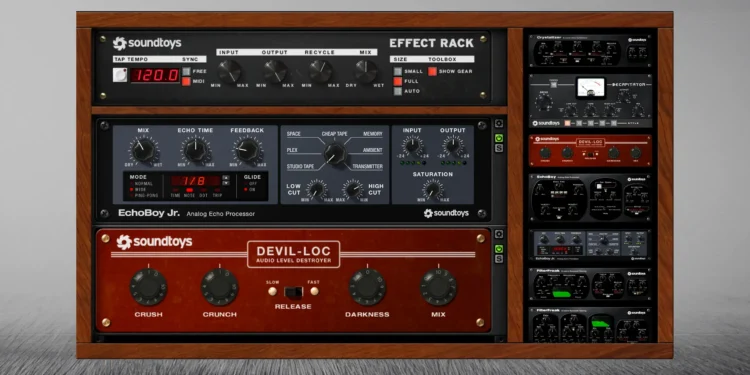
The era of digital audio production pursued unblemished sound until Soundtoys brought its authentic sound of analog equipment into digital plugins. Their tools recreate vintage hardware imperfections—tape hiss, tube warmth, erratic modulation—which transform pristine audio into expressive, distinctive music tracks. The transformation of effects created a novel artistic approach for producers who now see “imperfection” as their creative superpower.
This article looks at how the company created an entire new style of digital production by opening up new doors for musicians who want to explore sound through old-school techniques and analog design.
Rather than pursue a “perfect” clean sound with their tools, they offered a “warmer” and more unique character through saturation, grime, character, distortion, and various other creative effects that were ultimately human-made and therefore expressed the artist’s creativity.
By providing musicians with the ability to “experiment” with sound through new technologies, Soundtoys showed that imperfections can produce great creativity and completely alter the way modern audio products are designed.
Origins of Soundtoys
Soundtoys began from Wave Mechanics when engineers Sean Costello and others studied classic Eventide H3000 units. The team introduced their first independent plugins in 2000 with FilterFreak, which simulated 1970s bucket-brigade filters through an authentic sweeping sound and resonant behavior.
The 2014 Soundtoys 5 bundle brought together their complete toolset by including EchoBoy’s extensive collection of delay simulations that ranged from Roland Space Echo to EMT plate reverbs, demonstrating that digital technology could produce the same level of texture as physical equipment.
Embracing Analog Imperfections
Digital effects required perfect performance because they needed full transparency, yet Soundtoys used this standard to develop the wanted imperfections. Decapitator provides five analog saturation modes, which include Ampex tape crush and Neve console drive, which produce harmonic distortion that maintains mix integrity without introducing harshness.
Devil-Loc uses its 1940s compression to create an intense sound that enhances peak levels with punk-style energy, while Radiator produces a delicate tube light effect for both vocals and drums. These elements generate real-world noise and phase shifts, which create an authentic sound of environmental disturbances.
The Effect Rack Revolution
Soundtoys 5 Effect Rack enables users to combine 14 different plugins into a single system that features unlimited feedback loops through its global recycle function, which allows for the creation of modulated reverbs that standard DAWs cannot produce.
Crystallizer produces psychedelic soundscapes through its granular reverse-echo pitch-shifting technology, which generates sonic textures resembling Brian Eno’s musical experiments. PanMan and Tremolator create rhythmic modulation patterns that match tempo, but they lack the humanized swing found in standard plugins. Version 5.5 introduced SpaceBlender, which combines experimental reverb sounds to produce otherworldly audio environments.
Industry Impact and Usage
Professionals like Andrew Scheps (Adele, Red Hot Chili Peppers) use EchoBoy because it provides over 30 different delay options, which include both tape-style warble sounds and precise digital sound capabilities. Little AlterBoy enables users to create robot vocals and gender-shifting sounds, which have become standard in both pop and EDM music.
Soundtoys bundle powerfully dominates the musical compositions present in Metallica albums and Billie Eilish songs, which demonstrates its adaptability to different music styles. Soundtoys designed their effects to enable users to engage with effects through a simple interface while providing deep functionality because the design elements reveal groove adjustments and saturation baselines.
Why Imperfection Wins
Clean digital audio effects create uniform sound across all music tracks, while Soundtoys restores distinctive character through its imitation of natural sound faults. MicroShift uses 1980s chorus effects to create wider stereo sound, while PhaseMistress generates dynamic swirling filter soundscapes.
Soundtoys’ human-created sound faults will protect authentic production standards when artificial intelligence audio production increases in 2026. Their philosophy states that genuine magic exists in all glitches and growls and unpredictable sounds.